

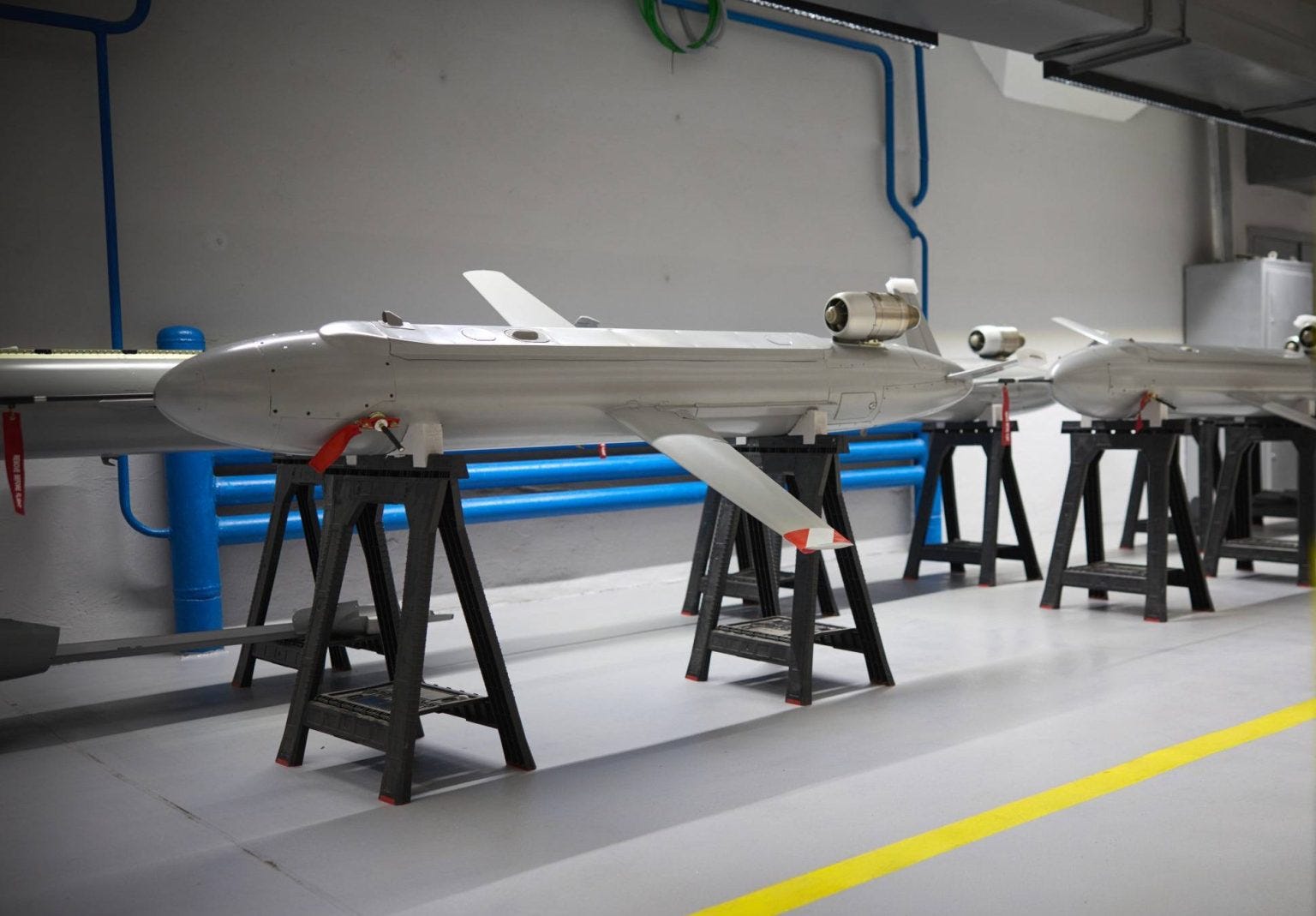
Picture: Office of the President of Ukraine
In April this year, President Zelensky announced a new framework agreement permitting controlled surplus weapons sales to partner countries.
In principle, this allows foreign buyers to access Ukraine’s significant and continuously increasing production capacity, expected to reach 55 billion USD in 2026, up from 1 billion USD at the start of the war.
This includes Ukraine’s increasingly capable and diverse deep-strike capabilities, including drones and missiles, which are in short supply across many of Ukraine’s partner countries, including in Europe, the Middle East, and Asia. Production capacity in this segment alone is quoted at up to 25 billion USD as of 2026.
This post examines the export potential of Ukrainian deep-strike capabilities. I focus on three factors that determine the export viability of Ukrainian drone and missile systems: internal constraints, competitive positioning in the global market, and broader structural factors affecting their exportability.
Internal constraints on Ukrainian deep-strike production
The export framework is built around a surplus rule. The Defense Ministry approved the implementing mechanism on 1 July, and sales across the five permitted categories (including long-range drones and missiles) must draw on Defense Ministry-certified surplus rather than frontline stocks. The first question is whether that surplus exists,