

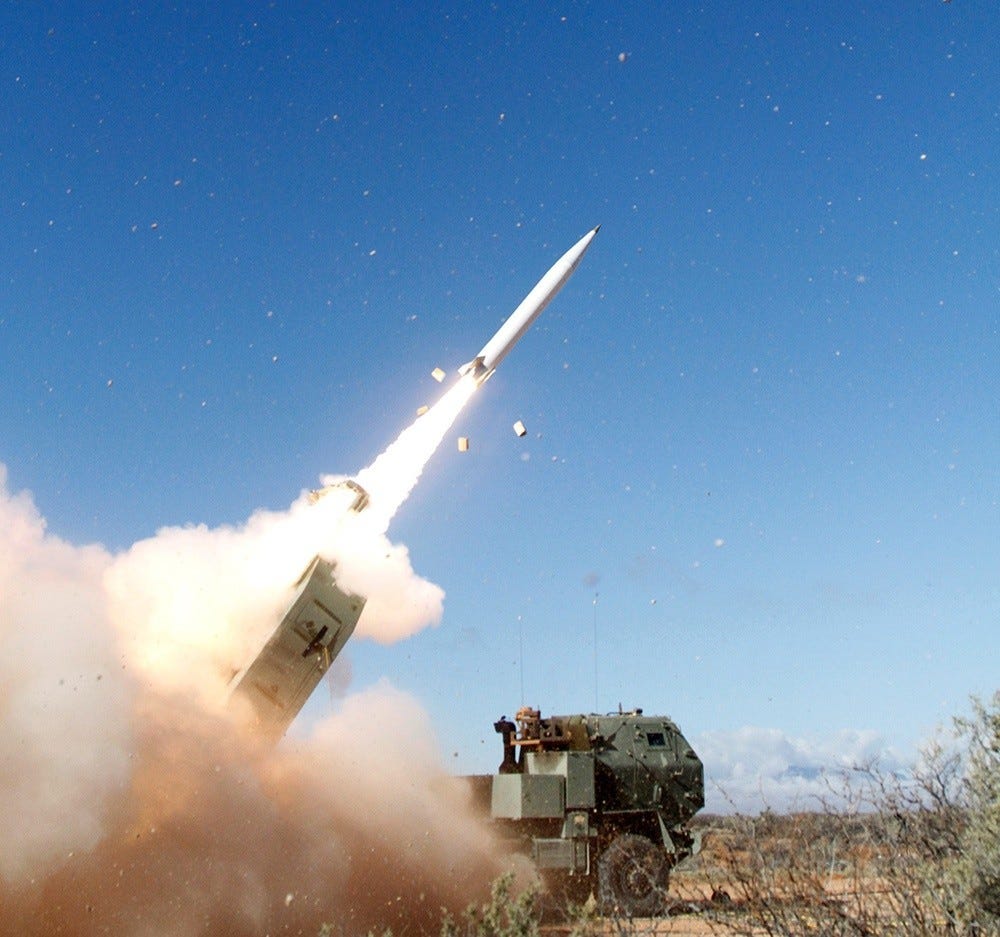
Picture: U.S. Army
The Precision Strike Missile (PrSM), the United States’ newest conventional ballistic missile capability, recently reached key testing milestones.
On 2 July 2025, PrSM Increment 1 received Milestone C approval, which authorizes the program to enter the production and deployment phase. On 25 July 2025, Australia conducted its first PrSM live fire during Exercise Talisman Sabre. Together, these developments mark a significant step toward full-rate production and broader fielding.
This post examines the current status of the missile program, potential exports and deployment among U.S. allies, and its implications in the Indo-Pacific and Europe.
Precision Strike Missile
The missile is the successor to the MGM-140 ATACMS short-range ballistic missile, which can be launched from the M142A1 HIMARS or the M270 MLRS rocket artillery system. ATACMS has been used by Ukrainian forces against Russian targets with several successful strikes, though Russian air defenses have claimed – and in some cases shown – intercepts of ATACMS.
In addition, ATACMS appears to have limited resilience to Russian electronic warfare. This is not entirely surprising, as Russian electronic warfare is known to have disrupted several GPS-aided or guided Western munitions, including some that are more modern than ATACMS and equipped with more robust electronics.
However, this has also not always posed a problem, since many of the ATACMS supplied to Ukraine are of the M39/M39A1-type, which are equipped with cluster munition warheads that do not rely on accuracy beyond what the missile’s inertial navigation system can provide.
The Precision Strike Missile offers an extended range of 500 kilometers compared to ATACMS’ 165 to 300 kilometers (100 to 180 miles). In addition, the U.S. Army procurement specification for the missile have required electromagnetic-spectrum survivability, suggesting the incorporation of upgraded electronics, including a hardened GPS receiver to improve resistance to Russian electronic countermeasures. However, specific anti-jamming or spoofing features have not been publicly disclosed.
According to the manufacturer, the Precision Strike Missile will initially be equipped with a unitary blast‑fragmentation warhead optimized for area and point targets. However, restrictions on warhead weight will constrain the quantity of fragmentable casing and preformed fragments, thereby limiting the missile’s area effects, especially when compared to cluster munitions, which disperse submunitions over a significantly broader footprint.
The new missile is also significantly smaller than its predecessor, allowing operators to load two Precision Strike Missiles per launcher pod instead of just one, as with ATACMS. The missile therefore not only provide an advanced capability profile, but also effectively doubles the firepower available to operators in the field.
PrSM variants
The United States’ missile will be produced in several versions. PrSM Increment 1 is the baseline version (500-kilometer range, unitary warhead) and is expected to reach initial operational capability in the coming months. The U.S. Army plans to procure a total of 3,986 Increment 1 missiles.
PrSM Increment 2 (also known as the Land-Based Anti-Ship Missile), expected to enter service in late 2027, will feature an extended range of up to 1,000 kilometres and a new terminal guidance suite with a multimode seeker that combines a passive radio frequency seeker and an imaging infrared seeker. This combination will enable the Precision Strike Missile to engage mobile land and sea-based targets, most notably enemy ships. In total, the current U.S. Army procurement objective stands at 1,589 Increment 2 missiles.
PrSM Increment 3 is intended to expand the range of payloads the missile can carry while retaining most of the technologies developed in Increments 1 and 2. Planned payloads include warheads designed to destroy hardened targets, including submunition warheads. Increment 3 is scheduled to enter service last after Increments 1, 2, and 4.
Finally, PrSM Increment 4 is expected to extend the missile’s range beyond the 1,000-kilometre threshold set by Increment 2, without altering the missile’s external dimensions. Concept images imply this may be achieved by replacing the conventional solid rocket motor with a more efficient airbreathing propulsion system. While details remain undisclosed, a plausible configuration could involve a first-stage booster transitioning to a second-stage solid-fuel ramjet.
A fifth Increment is also planned, which can be launched from an autonomous vehicle.
PrSM production
PrSM entered Low Rate Initial Production (LRIP) in December 2023, when Lockheed Martin delivered the first Increment 1 missiles to the U.S. Army following a production qualification flight test at White Sands Missile Range.
Since then, 42 PrSM Increment 1 missiles were scheduled to have been delivered to the U.S. Army by August 2025 for testing purposes, while several hundred have been procured in total since 2021.
In FY2024, the stated procurement number reached a three-digit figure for the first time, with 110 missiles procured. For FY2025, the number rose to 230, though this figure should be treated with caution and may not be fully reliable.
For FY2026, the U.S. Army initially targeted a procurement of 268 missiles. However, the President’s budget request included funding for only 45 PrSM missiles — 35 Increment 1 and, for the first time, 10 Increment 2. Following reconciliation, updated procurement funds now allow for a total of 152 missiles.
While Lockheed Martin has secured a 4.9 billion USD multi-year procurement contract and plans to ramp up production to 400 missiles per year, the current dip in procurement numbers is unlikely to support the development of a stable supply chain and production line. In any case, although reaching Milestone C will allow the PrSM program to transition from low-rate to full-rate production likely within the year, mass production remains some time off.
PrSM Increment 1 may also be built in Australia, currently the only U.S. ally slated to receive the missile (Norway requested it but was denied). Negotiations are expected to begin later this year.
Australia is already involved in several licensed missile production projects, including Kongsberg’s JSM, set to begin local manufacturing in 2027, and GMLRS, scheduled for production from 2029. Given these timelines, domestic production of PrSM in Australia should not be expected in the near term, even if a cooperation agreement is reached.
Another likely partner for licensed PrSM production would be Rheinmetall, which is significantly expanding its cooperation with Lockheed Martin in the missile sector.
So far, however, Rheinmetall appears focused on license production of ATACMS, which the manufacturer claims could begin in Germany from 2028. Given PrSM’s significantly more advanced capability profile compared to ATACMS, production in Germany would be desirable from both a German and broader European perspective, though it currently appears unlikely to materialize.
Strategic implications
The Precision Strike Missile will provide critical firepower to the United States and its allies, particularly in the Indo-Pacific region where the United States is preparing for a potential confrontation with China.
Given the vast distances in the region and China’s sophisticated anti-access/area denial (A2/AD) network, which poses a significant threat to U.S. freedom of operation in wartime, stand-off strike capabilities are urgently needed.
An advanced conventional ballistic missile capability may prove particularly valuable in this context due to its relatively short time to target. While a Tomahawk cruise missile takes nearly an hour to cover 1,000 kilometres, the PrSM Increment 2 will be able to traverse the same distance in approximately 5 to 10 minutes.
The new missile is therefore particularly well-suited to threaten mobile and semi-mobile targets, including Chinese Navy ships and relocatable land-based assets such as mobile missile launchers, mobile air defence radars and launchers, and forward-based command posts.
Nevertheless, challenges with the Precision Strike Missile program remain.
While PrSM Increment 1 offers a range improvement over ATACMS, its reach remains limited, particularly in the context of the vastness of the Indo-Pacific. To be relevant in a Taiwan scenario, the missile would likely need to be prepositioned on the island prior to the outbreak of war. However, current U.S. plans do not include deploying the missile – together with American operators – to Taiwan, nor does the United States appear intend on selling the missile to Taipei.
PrSM Increment 2 will provide the range upgrade needed to credibly threaten Chinese targets in the region, but it is not expected to enter service for several years. Even then, the United States will rely on allies such as Japan, South Korea, and the Philippines to provide basing options for the missile, which cannot be taken for granted, although some future deployments are likely.
In Europe, the PrSM Increment 1 variant would arguably be more useful than in the Indo-Pacific, given the shorter distances and the predominantly land-based environment of a potential confrontation with Russia. However, aside from planned deliveries to U.S. Army forces in Europe, no European armed forces are currently slated to receive the system.
Norway requested to purchase PrSM Increment 1 (along with GMLRS-ER) but was ultimately denied for unknown reasons. It remains to be seen whether other European countries will be permitted to acquire the missile.
Such an important point of comparing flight time for the PrSM II versus the Tomahawk. We can only hope that European politicians start to realize that not matching Russia when it comes to domestic ballistic missile production is moronic.
Thank you. Excellent article.👍