

Picture: Fabian Hoffmann / Missile Matters
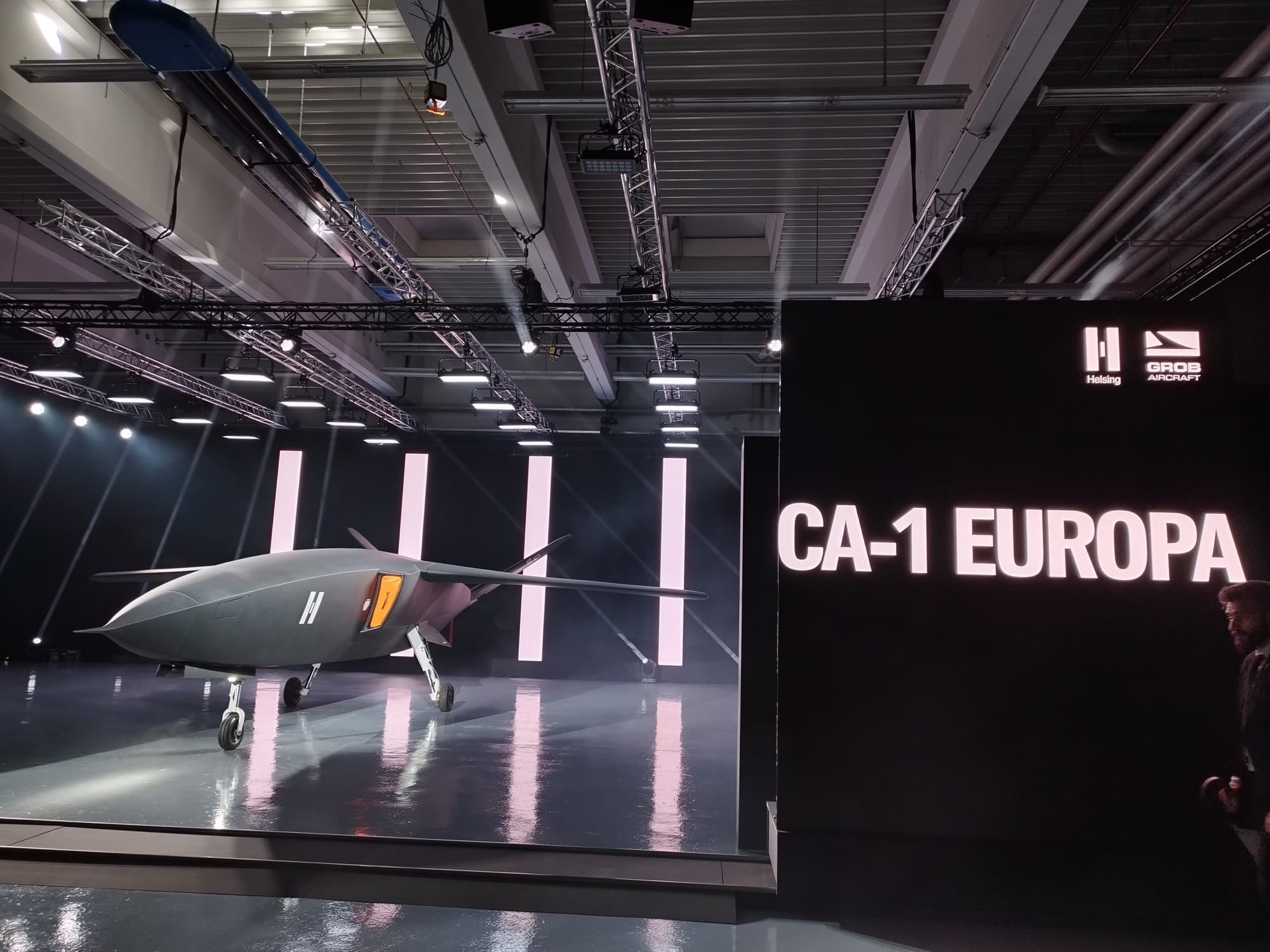
Earlier this fall, Helsing, Europe’s prime AI defense startup, showcased a new unmanned combat aerial vehicle (UCAV) at a launch event in Tussenhausen, near Munich, Germany — the CA-1 Europa.
What sets Helsing apart from its competitors, at least in the announcement accompanying the product launch, is its emphasis on the CA-1 Europa fulfilling a deep strike requirement for its operators. This suggests a role for the UCAV that goes beyond the collaborative and supporting functions with manned aircraft emphasized by other industry actors in the field, pointing instead to a strike mission intended to generate independent effects.
This coincides, likely not by accident, with the Bundeswehr recently issuing a requirement for a “Jagbomberdrohne” (fighter bomber drone), which, as the name implies, refers to a system capable not only of supporting airborne assets as a loyal wing man but also of independently executing strike missions.
This raises important questions: What is the future role of UCAVs in deep strike missions, and under what circumstances might they prove superior to traditional one-way deep strike systems? Can these types of UCAVs fill Europe’s deep strike requirement and perhaps compensate for its inferiority in traditional missile systems?
Factors affecting performance
Whether reusable UCAVs or one-way effectors, such as cruise missiles, ballistic missiles, or long range drones, are preferable for deep strike missions depends on several factors. The most important are unit cost, the likelihood of loss, the likelihood of destroying the target if the system arrives, and, for UCAVs, recurring operating costs for maintenance, refueling, and sortie generation.
Expected attrition is arguably the decisive variable for UCAVs. A reusable aircraft only makes economic sense if it can survive more than a single mission. UCAV attrition is also more structured than for missiles: there are losses on the way to the target and losses on the way out. In many scenarios the return leg is likely more dangerous, because the defender has been alerted, has a rough idea of the aircraft’s location following the strike, and may have had time to mobilize air defenses.
The second key variable is lethality once the platform arrives. Here a UCAV has a potential advantage. It can carry several payloads (for example, several guided or unguided bombs), and, if it survives over the target, it can engage multiple aimpoints in a single sortie. In principle, a single UCAV that reaches its target and performs as planned can therefore deliver effects comparable to several one-way effectors. If immediate battle damage assessment is available and the UCAV’s payload capacity allows it, it may also be possible to begin a second attack run to maximize success probability.
To compare performance in a transparent way, we can start by looking at expected costs. Assume a target with three aimpoints that all have to be destroyed to achieve critical damage. If each aimpoint is serviced by one missile, we can calculate the expected cost of the strike package as

Assume each missile has a 95 percent reliability, a 90 percent chance of penetrating enemy air defences, and a 90 percent chance of destroying its aimpoint once it arrives. Those three numbers multiply to a 77 percent chance that a single missile neutralises an aimpoint. On average, this means that about 3.9 missiles are needed to score three successful hits. At an expected cost of 3 million USD per missile, the expected cost of the strike package is roughly 11.7 million USD.
This model is a simple heuristic. It assumes that every missile has the same success probability and that each shot is independent. In reality, success probabilities often depend on the tactical situation, the defender’s alert state, and correlated failures within a salvo. The calculation also glosses over targeting issues by treating the extra “0.9 of a missile” as if it somehow knew exactly which of the earlier missiles would fail. In reality, operators would have to assume they do not know which missile or missiles will fail and allocate more than one to each aimpoint if they want to secure higher kill probabilities. Still, it is the standard expected value calculation used in reliability and attrition modelling for single-use systems and gives a useful first-order benchmark.
For UCAVs the situation is more complicated. Because a UCAV can survive the mission and return, and because it generates ongoing operating costs, it is not enough to ask how much one sortie costs. Instead, we want the long run expected cost per destroyed target, averaged over the UCAV’s whole life until it is lost. This requires a more detailed attrition model.
Assume a UCAV costs 15 million USD, each mission imposes an operating cost of 30,000 USD, and each munition costs 50,000 USD. For this example, assume the following: a 10 percent chance that the UCAV has to abort and return early due to some unforeseen event without being lost; a 5 percent chance that it is lost due to systemic failure (for example, engine or software problems); a 10 percent chance that it is shot down on the way to the target; and a 20 percent chance that it is shot down on the way back (reflecting the higher danger once the defender is alerted). If the UCAV reaches the target, assume it has a 90 percent chance of destroying the target, using three or more bombs against the three aimpoints.
Under these assumptions, the probability that a sortie both reaches the target and destroys it is about 69.5 percent. The overall probability that the UCAV is lost on that sortie, either due to systemic causes or enemy action on the way in or the way out, is about 29.6 percent. From these two numbers we can calculate the expected number of successful missions per airframe before it is lost. In this example, that figure, usually written as K, is about 2.33. In other words, each UCAV can be expected to deliver roughly 2.3 successful strikes before it is destroyed.
We can then calculate the long run expected cost per successful strike as

The first term in this model spreads the UCAV’s acquisition cost over the expected number of successful missions. In other words, it amortizes the 15 million USD purchase cost across the 2.33 successful missions the aircraft is expected to fly before being lost. The second term adds the average operating and ammunition cost needed to achieve one successful strike, taking into account that not every sortie will succeed.
In the numerical example above, the total long run UCAV cost per destroyed target, including acquisition, operating costs, and a representative ammunition cost, comes out at roughly 6.7 million USD per successful strike. Compared with the expected cost of the missile strike package of about 11.7 million USD, the UCAV delivers the same effect for roughly 43 percent less expected expenditure. Under these specific assumptions, employing a UCAV rather than one-way missiles is therefore more cost effective.
When are UCAVs less efficient?
Several conditions can push the expected cost of UCAV employment above that of one-way missiles, which directly follow from the model. Three factors matter most.
First, UCAVs become uneconomical when the expected number of successful missions per airframe falls too low. Because cost effectiveness scales with reuse, anything that pushes the loss probability toward or above the success probability will rapidly eliminate the UCAV advantage. High outbound attrition, high inbound attrition, or a combination of both will collapse K (i.e., the number of expected successful missions). Even modest increases in survivability penalties on either leg can push the amortized cost above that of a missile package. In the example above, scaling attrition rates by a factor of 1.8 to 18 percent inbound attrition and 37 percent outbound attrition, makes UCAV use unsustainable.
Second, UCAVs become less attractive when missiles have high per-shot success at low marginal cost. If a state can reliably achieve mission success with cheap or modestly-priced one-way effectors, the relative benefit of reuse shrinks. Low missile procurement costs, combined with adequate and lethality and penetration rates, shift the breakeven point toward expendable systems. In these cases, firing even a large number of inexpensive missiles or long-range drones may outperform flying a large, costly UCAV into a moderately dangerous environment.
Third, UCAVs lose ground when mission design prevents them from exploiting one of their main advantages. If the UCAV cannot overfly the target to distribute strikes, or if the target consists of only one aimpoint, the system’s operational flexibility becomes less relevant. Operating costs also matter, though at the margins. High maintenance burdens, limited availability, or high sortie generation costs can erode a potential cost advantage.
Of course, it is important to account for a major advantage of UCAVs not captured in the cost model, namely their ability to perform multiple roles and functions. Even if expected attrition in deep strike operations rises to unsustainable levels, it may still be possible to operate UCAVs for less risky tasks, including intelligence gathering in less contested areas of the theater, something one-way effectors inherently cannot do.
Overall, this discussion suggests that UCAVs may have a role in deep strike missions and can outperform traditional deep strike capabilities under certain conditions. They appear most competitive when the target is complex (i.e., it requires striking multiple aimpoints), expected attrition is low, and the best alternative is using high cost one-way effectors. Larger and relatively undefended industrial facilities deep behind the frontline that are out of range for, or lack vulnerability to, the small payloads often carried by more affordable one-way effectors may fit these characteristics.
DATELINE KYIV - DAY 1362 : 4288
A timely post. An interesting and thought-provoking analysis. Thank you.
V/r - IB
It might be useful to consider a broader mission portfolio for these systems. For example, using long range air delivered gliding munitions that are released close to the line of contact places manned aircraft at increased risk while extending the range of weapons penetration sufficient for operational interdiction missions. Using these systems would increase total payload available for a strike, if employed in concert with manned aircraft, would also reduce risk of loss for manned aircraft. Or, they could replace manned aircraft altogether for this mission profile. If the systems can be equipped with ballistic recovery parachutes then even if shot down they might be recoverable for salvage or repair. Considering their use for deep penetration missions might be using a corner of the operating envelope to decide the value of the concept while excluding the rest of the envelope where they may be more economical useful.